Gold Karats Explained: How to Calculate the Value of Your Gold Jewelry
What 24K, 22K, 18K and 14K really mean, the simple formula behind the melt value of gold jewelry, and what to expect when you sell.
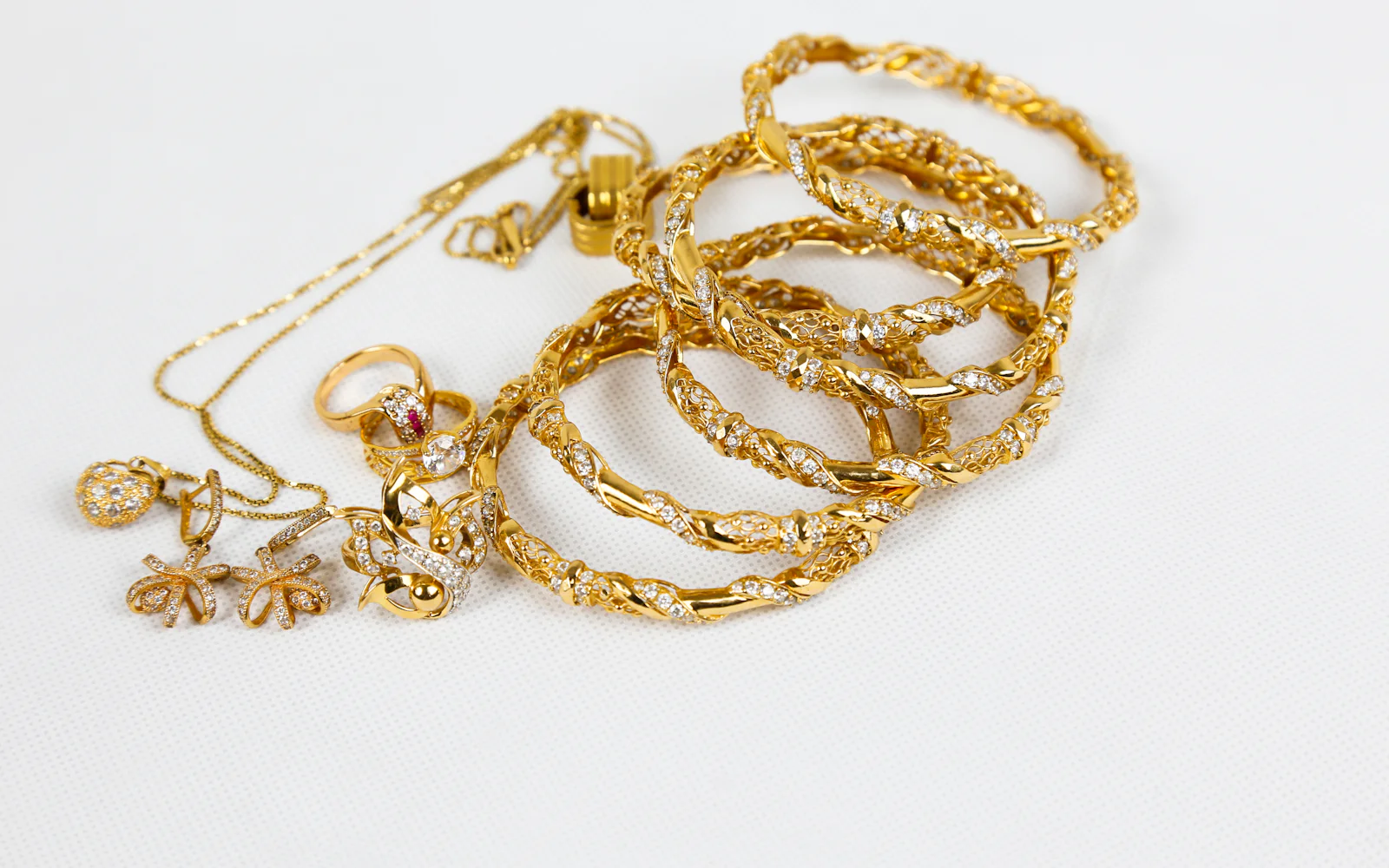
You have a ring, a chain or a bracelet stamped “18K” and you want to know what it is worth. The good news: the math behind the melt value of gold jewelry is simple. You only need three numbers — the weight, the purity and today’s gold price.
What does “karat” mean?
Karat (K or kt) measures purity on a scale of 24. Pure gold is 24 karat; 18K means 18 parts gold and 6 parts other metals such as silver, copper or zinc. Those alloys make jewelry harder and change its color, which is why rose gold and white gold exist.
Many countries also stamp purity as a three-digit fineness hallmark — parts per thousand.
| Karat | Gold content | Common hallmark |
|---|---|---|
| 24K | 99.9% | 999 |
| 22K | 91.6% | 916 |
| 21K | 87.5% | 875 |
| 18K | 75.0% | 750 |
| 14K | 58.5% | 585 |
| 10K | 41.7% | 417 |
| 9K | 37.5% | 375 |
Strictly, 14/24 is 58.3%, but 14K jewelry is usually hallmarked 585 so that it is guaranteed to meet the standard. When a piece carries a fineness stamp, use that number.
The formula
Melt value = weight (g) × purity × gold price per gram
Purity is the karat divided by 24, or the hallmark divided by 1,000.
Gold is usually quoted per troy ounce, so convert it first: one troy ounce is 31.1035 grams.
Price per gram = price per troy ounce ÷ 31.1035
A worked example
To keep the numbers easy, imagine gold is trading at $100 per gram (check the live price before you calculate anything real).
You have a 10 g chain stamped 750 (18K):
- Purity: 750 ÷ 1,000 = 0.75
- Pure gold content: 10 g × 0.75 = 7.5 g
- Melt value: 7.5 g × $100 = $750
The same 10 g in 22K (0.916) would contain 9.16 g of gold and be worth $916 at that price; in 14K (0.585) it would be $585.
Weigh it properly
A kitchen scale is not precise enough. Use a jewelry scale that reads to at least 0.01 g, and remember:
- Stones and pearls are not gold. Subtract their weight or ask a jeweler to estimate it.
- Clasps and springs on chains are sometimes a different alloy or a different metal entirely.
- Hollow pieces can look heavy and weigh very little.
What to expect when you sell
The number above is the value of the gold inside the piece. A buyer has to test, melt and refine it, and they need a margin, so offers on scrap jewelry are almost always below melt value. How far below varies a lot between buyers, which is exactly why knowing the melt value matters — it tells you whether an offer is fair.
The opposite is true when you buy: new jewelry costs well above its melt value because you pay for design, craftsmanship, brand and the retailer. That premium is usually not recoverable when you sell.
Check before you sell
- Look for a hallmark (often inside a ring band or on the clasp). No stamp? Have it tested.
- Weigh it on a precise scale and remove non-gold parts.
- Calculate the melt value with the current spot price.
- Get more than one offer and compare each one to the melt value.
Do it in seconds with MetalFolio
The karat calculator in MetalFolio does all of this for you: choose gold, silver or platinum, pick the purity from 24K down to 9K, enter the weight in grams or ounces and get the value instantly — in any of 30+ currencies, using the latest spot price.
This article is for information only and is not financial advice.